The sky broke when I was allowed to fly. / Se rompió el cielo cuando me dejaron volar.
May 16 – June 15, 2026
LA Artcore, Los Angeles
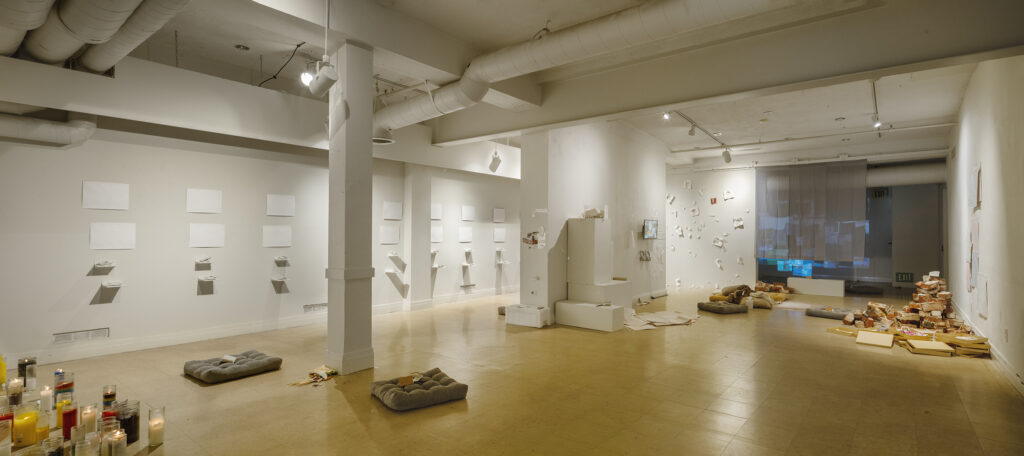
Installation view, The sky broke when I was allowed to fly. / Se rompió el cielo cuando me dejaron volar., LA Artcore, 2026. Photo: Panic Studios LA.
An exhibition by Nicole Rademacher. Video, drawing, installation, ceramics, language, and participatory work, developed over three years, including research trips to Monterrey, Mexico, where Rademacher met her paternal biological family for the first time.
The exhibition did not stay the same. Work made by participants entered it the day after it opened. A video was re-edited weekly. Visitors left marks in notebooks, rearranged and played with borrowed bricks, lit and extinguished veladoras. On the final day, it was taken apart by the people who came to take it apart. What follows documents one exhibition that existed in at least four states.
Exhibition Statement
I do not reclaim what was taken. I am claiming what was never given.
My work moves through unstable conditions of identidad / identity: partial access, delayed inheritance, misrecognition, and the gap between what is known, documented, and lived. As a white-passing, half-Mexican adopted person, I work from within histories and relationships that became available unevenly and often late.
Some things crack in the granting.
My paternal biological grandparents’ home in Monterrey, Mexico, was demolished before I was able to enter it. I learned Castellano as an adult, on my own, while my brothers grew up with our father’s español. These conditions are not background; they structure the work.
Language does not require equivalence to carry meaning. Translation is copied, mistranscribed, and broken into fragments. Errors are preserved. Meaning accumulates unevenly, across gaps.
Repetition, fragmentation, and desynchronization are not formal strategies applied to the work. They are conditions the work emerges from. Materials follow their own logic: vellum both holds and resists image; porcelain carries the residue of erasure; wax measures its own disappearance; bricks prestados / borrowed bricks carry the weight of a structure that no longer exists.
These materials do not recover what is missing. They document it.
Authorship is distributed. Some works are composed through the voices, writings, and memories of family I am still coming to conocer / know. What was visible was one iteration, shaped by what was available, what was remembered by others, what was entrusted to others, and what permanece / remains out of reach.
It does not resolve.
Works
Light. Luz/Lumbre/Ligera ~ Light. Light/Light/Light, 2026
16-channel video on suspended vellum screens, single projector, audio. Video 2:19; audio 3:33.
Sixteen vellum screens carried footage recorded in Monterrey. Audio and image were held deliberately out of sync — the gap between what is seen and what is understood left open rather than closed.
Con la esperanza de empatar rostros con nombres [With the hope that you can match faces with names], 2026
Porcelain, single-channel video, transcription in Spanish and English translation on vellum. Video 8:08.
Porcelain holding the missing profiles of Mexican biological relatives.
La cerámica tiene memoria [Ceramics hold memory], 2026
Twenty erasure drawings on bristol (11 × 14 in.), glazed porcelain patens with graphite debris, single-channel video.
The video was re-edited weekly across the run — four iterations, each replacing the last:
Iteration 1 — 4:09 (May 16–22) · Iteration 2 — 2:10 (May 23–29) · Iteration 3 — 2:19 (May 30–June 6) · Iteration 4 — 3:37:27 (June 7–15)
Lo que queda de lo que queda [What’s left of what is left], 2026
Veladoras; genealogical text written by Tía Mexicana Juanita C., printed in Spanish with handwritten English translation on vellum and newsprint, installed on floor and wall. Participatory installation.
Recurriendo a cimientos prestados [Leaning on borrowed foundations], 2026
Kraft archive boxes, bricks, charcoal pastel rubbings. Participatory installation.
The borrowed bricks are a variable keyed to site. In this instance they were lent from homes demolished after the 2025 Eaton Fire, on loan from SCI-Arc Faculty member Sophie Pennetier.
huellas susurradas [whispered traces], 2026
Kraft pocket notebooks (2.5 × 4 in.), colored pencils; marks, words, and drawings contributed by visitors across the run. Participatory installation.
Y nada más. [That’s it.], 2026
MiniDV camera with power cord, open tape compartment, extended LCD, new miniDV tape, empty cassette holder, headphones, acrylic case. Activated June 11, 2026. Video 1:01:35.
A score for one score beginning after one score and 6 years [Una partitura para una veintena que comienza después de una veintena y 6 años, 2026
Participatory deinstallation, June 15, 2026, 12–5PM
Score (instructions); residue retained.
The exhibition was taken apart by the people who came to take it apart. A written score directed the deinstallation through a set of bilingual fill-in-the-blank categories; participants sorted, removed, marked, and carried out the work according to it. The categories were both the instrument and the archive.
What remains is the residue.
The title’s arithmetic: a score (a document) for one score (twenty years) beginning after one score and six years (twenty-six — the age of first contact with biological family — to forty-six, the first visit to Monterrey).
Deinstallation here is not takedown. It is the last participatory act of the work, and the first of whatever follows.
aún sin título [still untitled]
May 17, 2026, 1–6PM
Five-hour facilitated convening, co-facilitated by Nicole Rademacher and traci kato-kiriyama.
aún sin título was not a program attached to the exhibition. It was a piece of it. Using Rademacher’s own work as its point of departure, it asked whether the somatic framework she has developed — grounded in museotherapy — could be carried, altered, and extended by others.
The convening was for adults disconnected from their cultural heritage through adoption, foster care, immigration, displacement, or family silence. Participants moved through guided deep looking and somatic awareness, then responded through embodied writing and reflective art-making, bringing their own fragments: photographs, documents, objects.
Work made during aún sin título was installed in the exhibition for the remainder of its run. The exhibition shifted as other histories entered it.
Work developed through aún sin título:
ALS, RE-ORDERED BITS OF LETTERS FROM ME COMING OUT TO MY HOMOPHOBIC FATHER, 2026
mixed media, installed in collaboration with the artist
Corinne, traces of the unknown, 2026
mixed-media installation, installed in collaboration with the artist
Diane Campbell, currently untitled, 2026
somatic response captured by Nicole Rademacher, installed in collaboration with the artist
Niloofar Ojani, Becoming [then and now], 2026
paper art in a kraft archive box, installed by Niloofar, installation altered by vistors
saki, Monadic Repetition, 2026
video with audio, installed in collaboration with the artist. Video 5:21
Distributed authorship
This work would not exist without the collaboration and confianza / trust of my birth parents, my biological brothers, and my extended family in Monterrey, Mexico. It is their openness, memories, experiences, and voices that compose it.
Homero Cerón · Denise Janquart Cerón · Andy Cerón · Pablo Luís Cerón · Primo Adrián Hernández · Javier Hernández · Tía Paterna Selvia Edith Cerón González · Prima Yolanda Cerón · Tío Roberto Cerón · Juan Rubén Guillén Cerón, hijo de Hortensia Cerón García, hermana de Homero Cerón García · Adriana García y Oswaldo Garza, amigos de Homero Cerón desde la infancia · Tía Mexicana Juanita C.
and many others — I am waiting for their permission to name them publicly.
Supported in part by the California Arts Council, the Adoptees for Awareness Grant, and the City of Los Angeles Department of Cultural Affairs.
Exhibition documentation by Panic Studios LA, photographed in two states: as installed, and as changed. Deinstallation documentation conditions vary; some material was recorded by participants.